

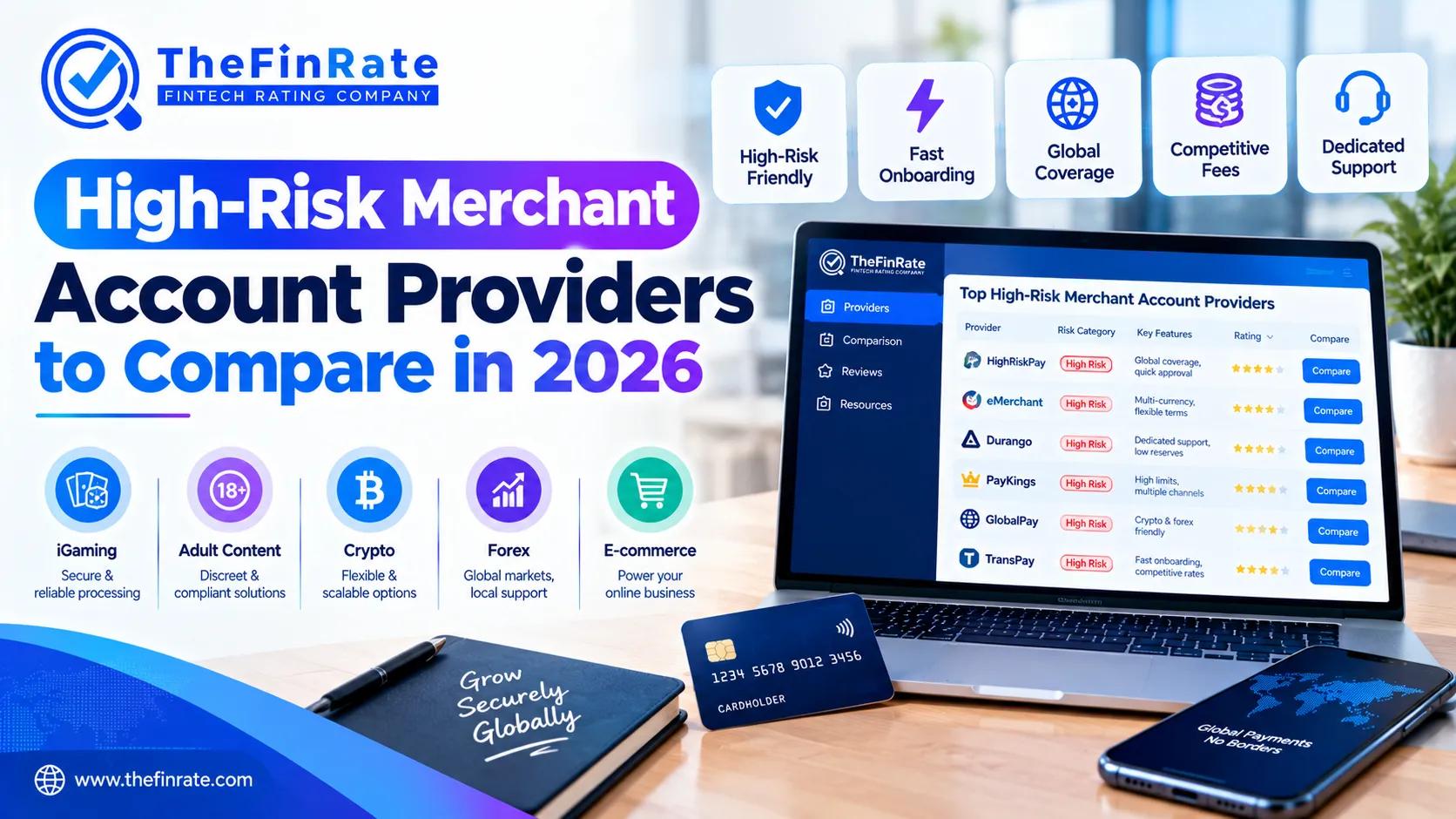
If a mainstream processor has declined you, or you expect it to, you need a provider that underwrites riskier businesses. This guide compares six high-risk merchant account providers on what decides your cost and stability: pricing transparency, account model, reserves and contract terms. The list is alphabetical, not ranked. Details were last checked on 19 October 2026 and change often, so confirm everything with the provider before you apply. For a broader view of how we present provider evaluations, see our reviews and ratings.
Key takeaways
Most high-risk providers quote prices only after underwriting, so published rates rarely show what you will pay.
Reserves, long contracts and early termination fees often cost more than the headline rate.
Some providers act as payment service providers (PSPs) under their own master account. Others give you your own merchant account. Control and risk differ.
What makes a merchant account high-risk?
Providers classify a business as high-risk because of its industry, its chargeback history, or both. Common triggers are high chargeback rates, a prior account termination, high-ticket sales and card-not-present selling. Gambling, CBD, travel and subscription services are typical examples. Each processor sets its own definition, so a business one provider treats as moderate risk may be high-risk to another. If you are still learning the basics, our guide to high-risk merchant services explains how the category works.
How to shortlist providers
Industry fit. Check that your exact vertical is accepted, not just "high-risk" in general.
Account model. Decide between a PSP-style account under the provider's master account and your own dedicated merchant account.
Monthly volume and average ticket. Underwriters weigh both, and some providers focus on certain volume bands.
Gateway needs. Confirm which gateways are supported and whether a backup is available. Our payment gateway reviews can help you compare options.
Exit terms. Ask about contract length, early termination fees and payout holds after you close the account.
Providers at a glance
CCBill: adult and other hard-to-place verticals. PSP or ISO model. Partial public pricing.
Durango Merchant Services: broad high-risk coverage with international and offshore options. Quote-based pricing.
eMerchantBroker: wide range of high-risk industries. No disclosed pricing.
Host Merchant Services: eCommerce and retail with some high-risk accepted. Published rates apply to low-risk accounts only.
PaymentCloud: medium and high-risk US merchants. No disclosed pricing.
SMB Global: high-risk and offshore merchants only. No disclosed pricing.
None of this comes from TheFinRate testing. It reflects provider statements and third-party reviewer reports, so verify before relying on it.
Provider mini-reviews
CCBill
CCBill combines a gateway with underwriting and consumer billing. It describes a PSP model, where merchants sit under its master merchant account, and an ISO model, where merchants get their own account. Reviewers report a rolling reserve and a six-month minimum hold on payouts after cancellation. Fee figures conflict across sources, with adult rates reported at 10.8% to 14.5% and annual registration fees reported at different amounts. Treat all of them as unconfirmed until you see CCBill's current pricing page.
Suitability: adult and subscription merchants who value an all-in-one setup.
Limitation: higher costs and a reserve are likely.
Durango Merchant Services
Durango places merchants with a range of banks and processors. Reviewers report international accounts with multicurrency support, plus offshore options for some high-risk industries. They also note that Durango may attach conditions to high-risk accounts, including rolling reserves. Pricing is quote-based.
Suitability: merchants who need international or offshore options.
Limitation: you cannot compare cost before applying.
eMerchantBroker
Reviewers say eMerchantBroker accepts most traditionally high-risk industries and has a short prohibited list. They also note it is usually not the cheapest option and that contracts include an early termination fee. It does not publish pricing.
Suitability: merchants turned down elsewhere.
Limitation: negotiate terms and read every document before sharing bank details.
Host Merchant Services
Host Merchant Services is known for interchange-plus pricing and month-to-month billing, but high-risk accounts carry different pricing and contract terms. Reviewers report that high-risk services come through a partnership with Electronic Merchant Systems, so the website rates do not reflect what a high-risk merchant will see.
Suitability: eCommerce and retail merchants at moderate risk.
Limitation: read the high-risk contract separately from the website terms.
PaymentCloud
PaymentCloud is not a direct processor and does not offer offshore accounts. It does not disclose rates, though it offers flat-rate, tiered and interchange-plus models. One reviewer reports a standard two-year term. PaymentCloud itself says it cannot guarantee approval for applicants with credit challenges. A third party estimates high-risk transaction fees of 2.7% to 4.3%, which is not a quote.
Suitability: US merchants who want a domestic account.
Limitation: no public pricing and a two-year term.
SMB Global
SMB Global works only with high-risk and offshore merchants and publishes no rate or fee information. Reviewers report that early termination fees are hard to avoid unless you are a very high-volume merchant.
Suitability: very high-risk or offshore needs.
Limitation: moderate-risk merchants may find better terms elsewhere.
Questions to ask before you apply
Is this a PSP-style account or my own merchant account?
What is the reserve type, percentage and release schedule?
What are the contract length and early termination fee?
How long are funds held after I close the account?
Which gateways are supported, and can I add a backup?
What are the chargeback fees, and which ratio triggers a review?
Who is the sponsoring bank, and what happens if that relationship ends?
For a wider look at ranked options, see our best high-risk merchant accounts guide.
Red flags
Guaranteed approval before underwriting
Upfront fees with no written terms
Unclear reserve language
Pressure to hand over bank details before the contract is final
No access to the full merchant agreement
How to compare quotes fairly
Ask each provider for the same package: your volume, average ticket and refund rate. Then compare total monthly cost, including reserve, monthly minimums, gateway fees, chargeback fees, annual registration fees and payout fees. Compare exit costs too. A lower rate with a long contract and a payout hold can cost more than a higher rate with clean exit terms. Our guide to high-risk merchant accounts for risky industries covers managing an account after approval.
FAQs
What is the MATCH list? It is a Mastercard database of merchants whose accounts were terminated for certain reasons. Listings generally expire after five years, and merchants are typically not notified when added. Some high-risk providers board listed merchants case by case.
What is a rolling reserve? It is a percentage of each sale that the provider holds for a set period to cover chargebacks and refunds, then releases on a schedule. Percentage and period vary by provider and risk level.
How long does approval take? It depends on your documents, industry and history. Any timeline you see is an estimate, not a promise.
How can I keep my account stable? Keep chargebacks low, respond to disputes quickly and stay within your declared business model. Consider a backup processor so one termination does not stop all sales.
Can I still use a standard processor? Sometimes. Some mainstream processors accept moderate-risk businesses, but they may restrict or close accounts later, so read the prohibited-business list first.
H. Verdict and CTA
No provider here is best for every merchant. Fit depends on your vertical, volume, chargeback history and tolerance for reserves and long contracts. Use the questions above to compare written quotes, not marketing pages.
CTA: Compare providers by industry and region in TheFinRate's merchant account provider directory, and review each provider's requirements before requesting a quote.