

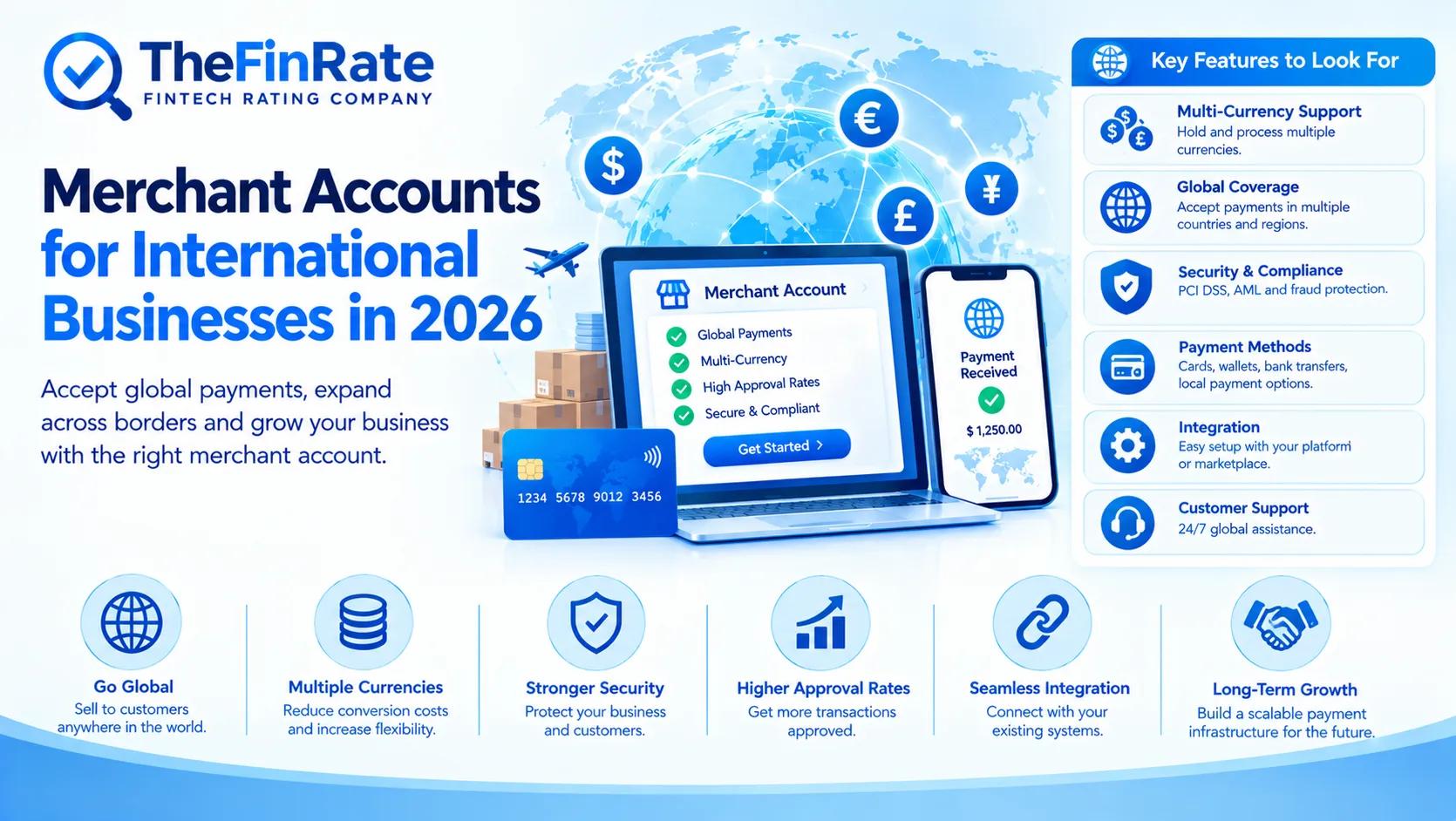
Merchant Account for International Businesses: Options, Requirements and How to Choose
If you sell to customers in other countries, the question is rarely "do I need an international merchant account?" It is "which setup lets customers pay in a way they trust, lets me be paid in a currency I can use, and keeps my costs and compliance under control?" The answer depends on where your business is registered, where your customers are and how much you sell.
This guide explains what a merchant account for international businesses is, the main ways to set one up, what providers typically ask for and how to compare options. To browse providers while you read, use TheFinRate's merchant account providers directory.
Quick answer
An international merchant account lets a business accept card and local payments from customers in other countries and currencies. In practice there are three common routes:
A payment service provider (PSP) account, where the provider holds the merchant account structure and you onboard onto it. Often the fastest way to start.
A direct or enterprise setup, where a provider acts as processor and acquirer and negotiates pricing, usually for higher volumes.
A local entity and local acquiring setup, where you register a business in the target market so payments settle locally.
The right route depends on your volume, your markets, your industry risk level and whether you need to settle in more than one currency.
What is a merchant account for international businesses?
A merchant account is the account that receives card payment funds before they are sent to your bank. A payment gateway is the technology that passes payment details securely between your checkout and the payment network. A PSP often bundles both. For a plain-language explanation of the other roles, see TheFinRate's overview of payment providers.
The word "international" usually describes one or more of these features:
Accepting cards issued in other countries
Showing prices in customers' own currencies (presentment currency)
Receiving funds in a currency other than your home currency (settlement currency)
Supporting local payment methods, not only cards
A multi-currency business bank account is different. It holds and moves money in several currencies, but it does not by itself let you accept card payments.
Three ways to get an international merchant account
1. PSP or platform account
Providers such as Stripe and PayPal's Braintree let a business sign up online and start accepting payments across borders. Stripe's documentation says merchants can charge customers in more than 135 native currencies, and that if the charge currency differs from your settlement currency Stripe converts the charge. PayPal's Braintree documentation says it supports more than 130 local currencies in 44 countries, and that a merchant account is set up in your home currency by default, so multi-currency needs configuration.
This route suits startups and small to mid-sized sellers. The trade-offs are country eligibility (you generally need to be registered in a supported country), conversion costs and account reviews that follow the provider's risk rules.
2. Enterprise processor and acquirer
Adyen describes itself as the acquirer and holds acquiring licences with the card schemes in major markets. Its pricing page lists a fixed processing fee plus a payment-method fee per transaction, with Visa and Mastercard on Interchange++ plus 0.60%. Published figures are indicative and it invites merchants to discuss pricing. This route suits larger or multi-region merchants that want local acquiring, many payment methods and negotiated pricing.
3. Local entity with local acquiring
Some merchants set up a legal entity in a target market so customers pay a local acquirer and funds settle in the local currency. Checkout.com describes like-for-like settlement as being paid in the same currency the customer paid in, which avoids conversion and its fees, and notes that establishing a local legal entity is a key step for local compliance and tax handling. This route can improve cost and acceptance in a core market, but it adds legal, tax and banking work, so take professional advice first.
What international merchant account providers typically ask for
Requirements differ by provider and country, but applications commonly include:
Business registration documents
Identity documents for owners, directors or other controlling persons
A business bank account for settlement, sometimes with recent statements
A website showing what you sell, your prices, delivery and refund terms, and contact details
Information on products, expected volumes and average order value
Stripe's multi-currency settlement documentation also notes that you must provide a separate supported bank account for each settlement currency, and that the bank account currency must match. Prepare these items early, because mismatched company details between documents and bank accounts are a common cause of delays.
How currency and settlement work
Presentment currency is what the customer sees and pays in.
Settlement currency is what lands in your bank account.
Conversion happens when the two differ, and it carries a cost.
By default, Stripe converts incoming funds into the default currency of your home country, while multi-currency settlement, available in selected locations, lets you hold and pay out in additional currencies without FX fees on those balances. Always check whether your registered country is eligible, which currencies are supported, and whether minimum payout amounts or fees apply.
What international acceptance costs
Headline rates are only part of the picture. Compare:
The base processing fee and fixed fee per transaction
Surcharges for international or non-domestic cards
Currency conversion margins
Payout fees for non-domestic bank accounts or non-home currencies
Dispute and refund fees
Any monthly minimums, setup fees or reserves
Stripe's documentation, for example, states that payouts in a currency other than the primary currency of the recipient bank account's country incur a fee. The same pattern appears across providers, so ask for the full fee schedule in writing.
Compliance and risk: what to plan for
Cross-border selling brings extra obligations. Plan for these before you apply:
Know-your-business checks. Providers must verify who owns and controls the company. Incomplete or inconsistent documents slow approval.
Industry risk. Providers apply their own rules to sectors they consider higher risk and may decline them, require reserves or route you to specialist providers.
Tax and licensing. Selling into another country can create tax registration or licensing duties. This guide does not replace advice from a qualified adviser in the relevant countries.
Card security. Choose providers that handle card data under recognised security standards so your checkout does not store card numbers.
A merchant account should never be used to hide who owns a business or to avoid local rules. Reputable providers will refuse applications that attempt that.
How to choose a merchant account for international business
Map your customers. List the top countries and currencies by revenue or expected revenue.
Pick your settlement currencies. Decide where you want funds to land and whether you need more than one bank account.
Check eligibility. Confirm the provider supports a business registered in your country and your industry.
List the payment methods customers expect. Cards may not be enough in some markets.
Request the full fee schedule. Include conversion, payout, dispute and refund fees.
Ask about reserves, holds and payout timing. Cash flow matters as much as price.
Test with your real numbers. Model three months of sales per market.
Plan a backup provider. One review or outage should not stop all international sales.
Common mistakes
Treating a multi-currency bank account as a merchant account.
Choosing a provider for the home market and discovering later it does not settle in your needed currencies.
Ignoring conversion and payout fees.
Submitting documents whose company name or tax details differ across the application and bank account.
Applying with a website that lacks refund, delivery or contact information.
Assuming every provider accepts every industry.
D. Comparison table and checklist
Setup models (insert under "Three ways to get an international merchant account" or as a summary table)
Setup model | How it works | Often suits | Points to verify |
|---|---|---|---|
PSP or platform account | Sign up online and use the provider's merchant structure | Startups, SMBs, SaaS, online sellers | Eligible countries, supported and settlement currencies, conversion and payout fees, review rules |
Enterprise processor and acquirer | Provider acts as processor and acquirer with negotiated pricing | Larger or multi-region merchants | Pricing is indicative, onboarding effort, volume expectations |
Local entity and local acquiring | Company registered in the target market; payments settle locally | Merchants with a major market worth the setup | Legal, tax and banking requirements, ongoing compliance cost, professional advice |
This is a framework, not a ranking of providers.
FAQs
Do I need an international merchant account to sell abroad? Not always. Many PSPs let you accept foreign cards and currencies on a standard account. A dedicated or local setup becomes relevant at higher volumes or when a market needs local acquiring.
What is the difference between a merchant account and a payment gateway? The merchant account receives card funds before payout to your bank. The gateway securely passes payment details between your checkout and the payment network. Many providers bundle both.
Can I get paid in my own currency? Usually yes, but conversion may apply if the customer pays in another currency. Some providers offer settlement in additional currencies in eligible countries, often with a bank account for each currency.
Which documents do I need? Typically business registration, identity documents for owners or directors, a settlement bank account and a website with clear policies. Requirements vary by provider and country.
Will a provider accept any industry? No. Providers set risk rules and may decline, restrict or ask for reserves in some sectors. Disclose your business model honestly at application.
H. Verdict and CTA
Verdict. There is no single best merchant account for international businesses. A PSP account is often the practical start for smaller sellers, an enterprise acquirer suits larger multi-region operations, and a local entity setup makes sense when one market justifies the extra legal and banking work. Decide on your customer countries and settlement currencies first, then compare providers against them.
CTA. Ready to compare options? Browse payment gateway providers on TheFinRate, then shortlist providers and request their full fee schedules in writing.